Charles Taylor Book Award Co-Winner 2026: Lisa Björkman, Drama of Democracy: Political Representation in Mumbai
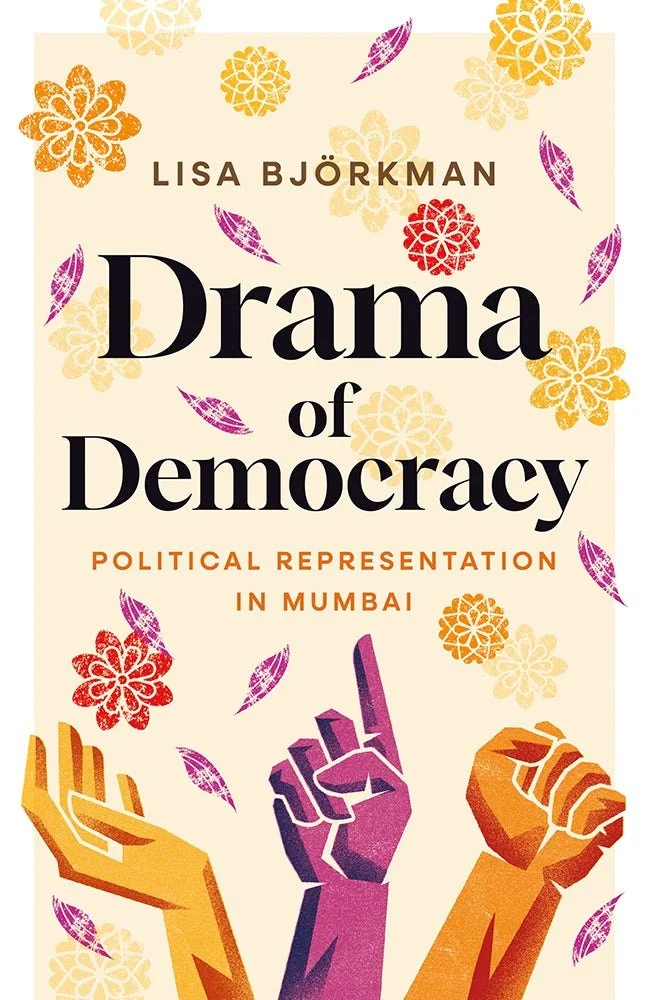
Winner: Lisa Björkman (University of Louisville) for Drama of Democracy: Political Representation in Mumbai (University of Minnesota Press)
In The Drama of Democracy, Lisa Björkman puts the power of interpretive methods on full display, drawing on a deep and contextualised understanding of Mumbai’s local politics to make sense of populist performances and affective politics. Her work compellingly demonstrates a need to rethink democratic representation as simultaneously performance and reality. Björkman leverages a compelling array of methods to illustrate that there is no contradiction between representation and action – the latter constitutes the former. Representation itself is not the absence of a thing, or even an abstraction, but the manifestation of the intangible in concrete form. This insight reshapes our understanding of democracy as a meaning-making process, with representation as a performative interplay between audience, principal, and context. Björkman is careful to highlight that these tools do not belong to any particular set of political values, but rather have universal salience.
Björkman also recontextualizes facets of democratic practice, like cash flows during elections, which have been seen as transactional corruption, or vote-buying, and instead argues that for participants, the ability to command and distribute funds is a show of capacity and willingness to work. In another particularly interesting reframing, Björkman puts mass prayer by religiously-aligned parties and partisans in parallel to protests and other shows of political force that expands the conversation on repertoires of contention.
In addition to these broad insights, each chapter offers a careful analysis of local political practices in Mumbai, adding new depth of understanding to how politics functions in patrimonial contexts. In her collection of evidence, Björkman takes a truly ecumenical approach, blending analysis of visual and spoken media, embodied practices and abstract forms, the collective effervescence of the crowd and the tactility of the objects that facilitate representation.
We would like to also commend the author for making her book open access, creating a knowledge economy that is accessible.
The methodological care and consistency, and conceptual contributions, made by Björkman in The Drama of Democracy make this book an important intervention in our understanding of democracy, representation, performance, and participation.
Selection Committee:
Carolyn Holmes (Chair), University of Tennessee – Knoxville
Joanna Wuest, Stony Brook University
Rebecca Tapscott, University of Glasgow