Charles Taylor Book Award Co-Winner 2026: Alexis M. Lerner, Post-Soviet Graffiti: Free Speech in Authoritarian States
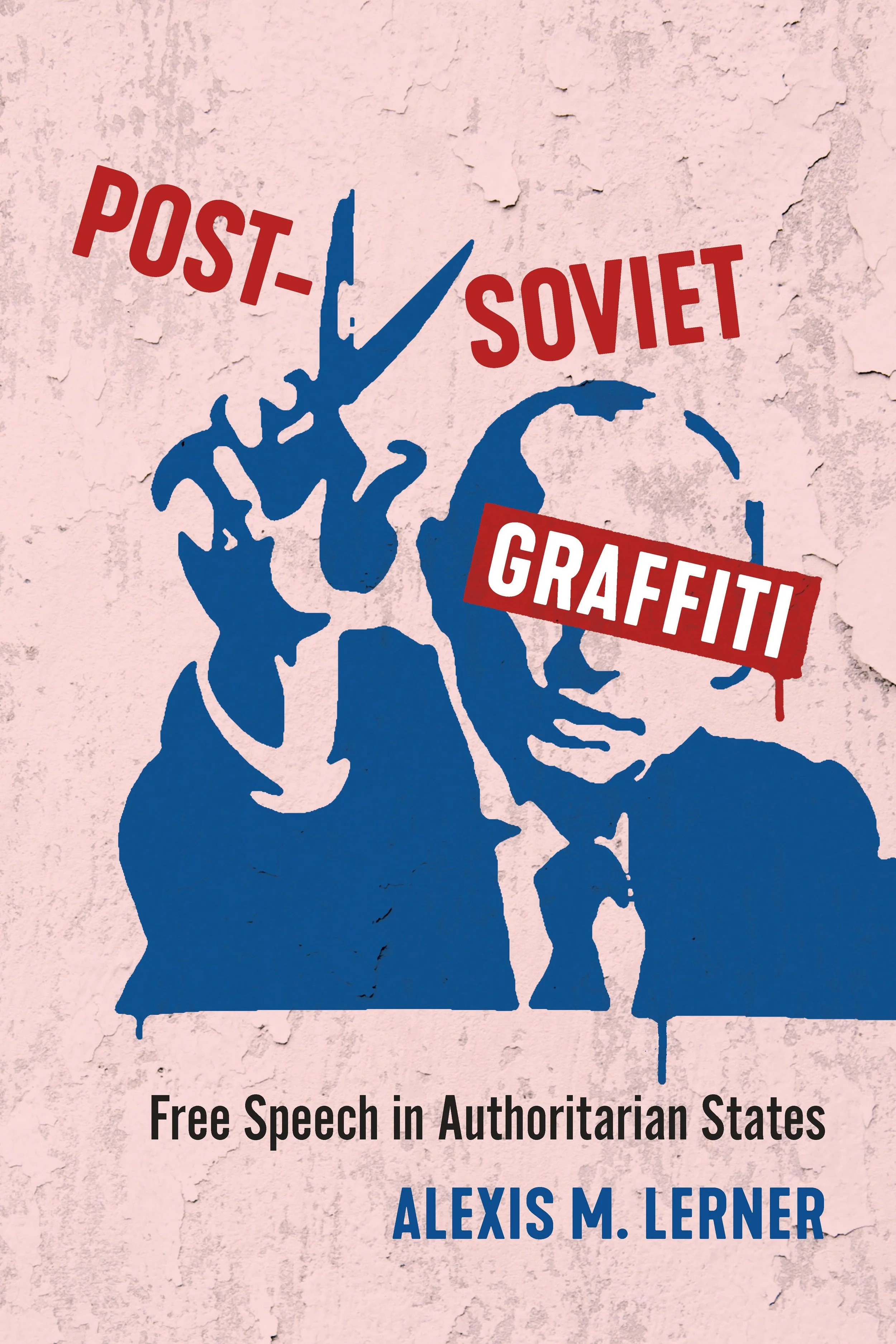
Winner: Alexis M. Lerner (United States Naval Academy) for Post-Soviet Graffiti: Free Speech in Authoritarian States (University of Toronto Press)
Alexis Lerner’s book is a masterful examination of an ephemeral world of meaning-making across a wide swath of the post-soviet world. In examining the street art and graffiti used to articulate dissent and in authoritarian spaces, in the midst of changing legal codes, regime orientations, and context, Lerner examines a domain of speech and political action that would simply be inaccessible to observers without a deep immersion in spaces in which these visual speech acts are conducted and viewed. Focusing on a previously under-examined form of protest, which is anonymous, public, and impermanent, Lerner’s analysis vastly expands our understanding of opposition and contention in hybrid and authoritarian spaces, as well as the cooptation of graffiti by regime actors.
Part of the strength of Lerner’s book comes from its sheer scope, across both time and space, which is engaged without sacrificing a deep and immersive knowledge of the spaces in which her research takes place. Lerner’s work involves an impressive range of sites, languages, and sources of information. Throughout the book, she traces longer-term trends, like changes in political openness, and the involvement of government actors to co-opt critics through micro observations over time.
The flow of the book’s argument is also novel. Beginning with an oral history of graffiti artists and their practices, Lerner traces the evolution of the art and speech of these public interventions from the Soviet era to the 2020’s. Situated at the intersection of public speech, commodification, international influence, and the local milieu, graffiti itself became a domain for contesting authenticity and meaning-making. The second part of the book examines graffiti as text and speech, public contention, and the connection between graffiti and action. In a particularly interesting chapter, Lerner uses Russian and Eastern European literary criticism to analyze graffiti as narrative and text. The final section of the book Lerner examines the intersubjective and interactive nature of graffiti in creating, destroying, and contesting political and social power and identity.
Methodologically, Lerner’s book is eclectic in the best tradition of interpretivism, drawing from diverse informative sources, from interviews and photographs to digital media and protest events. The committee would especially like to commend Lerner’s inclusion of so many images throughout her book, which lend both literal and figurative color to the reading experience. Lerner’s command of idiographic language and meaning are impressive, given that graffiti “speaks” in images, symbols, idioms and slang. Her more than ten years of immersive fieldwork across the region are evident throughout.
Post-Soviet Graffiti makes a substantial contribution to our understanding of speech, the public sphere, and contestation in hybrid and authoritarian contexts. Moreover, it is a fascinating window into a world that Lerner’s work makes uniquely visible through her immersive and thorough explorations of space, language, and meaning.
Selection Committee:
Carolyn Holmes (Chair), University of Tennessee – Knoxville
Joanna Wuest, Stony Brook University
Rebecca Tapscott, University of Glasgow